If I Had to Start Over
- Details
- Category: Learning To Shoot
- Wednesday, June 19, 2013 - 11:23
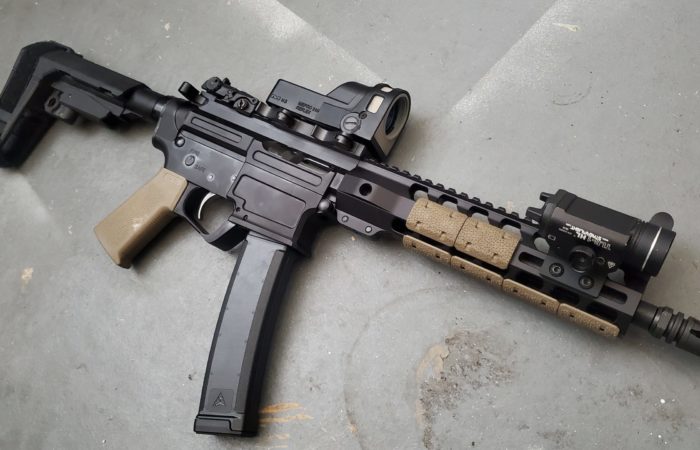
When I first got into AR15's I was on a shopping spree. Living at home when I turned 18 (10 years ago) I was able to dump money into AR15 after AR15. I purchased 4 lowers and embarked on 4 misc. build projects. One of them a (9mm ar15) was never completed. I wasted much time and money on equipment that i didn't need. Had I stuck with one gun and a few things before gun #2 I could have really understood and mastered my rifle. I didn't do that. I wasted money.
Money Wasted:
Looking back I realize how much money I spent on extra rifles and misc gun related junk instead of real equipment to help me become a better shooter. Instead of 4 lower receivers and misc builds I should have pared it back. It was tempting to drop $120 dollars on a lower and walk out with a new project gun... but a wise man once said you can only shoot one gun at a time.
Starting out right:
Right off the bat, for a new AR15 owner, I would recommend you buy a spotting scope, shooting mat, and good rifle case. When I headed to the range and sat around wasting time to set up and score my targets I could have pasted 3 or 4 targets and adjusted my zero from the comfort of my bench. Instead I waited for other shooters to call the range cold and then I would collect my targets. A spotting scope lets me see my target and adjust my zero from one position. A shooting mat lets me practice prone when things are muddy or wet. A good case holds and organizes all my gear in one "grab and go" bag. Maximize your time at the range, especially if you cannot go that often.
Next up would be a case of ammo. Right now ammo prices make this idea seem out of reach for many shooters. Hopefully prices will come down. The key to the case of ammo is that it will allow you to shoot the same stuff every time you hit the range. Changing ammo types will lead to frustrating range sessions as different ammo will require a different zero in some cases. A case of ammo that your rifle likes will let you keep shooting and working on your skill rather than worrying if the new box of ammo you just got requires a zero adjustment. Eliminate the variables and buy the same box of ammo every time if nothing else.
A spare parts kit is a great thing to have. I have been to the range and have had things come loose and have had stuck cases and other miscellaneous malfunctions. I can't get out to the range every week... so if I can fix a broken rifle right there on the spot more power to me. When others and yourself are engaged in rifle training there will invariably be a parts breakage for someone. It is nice to provide a spare for a fellow shooter as this builds relationships and makes going to the range more interesting.
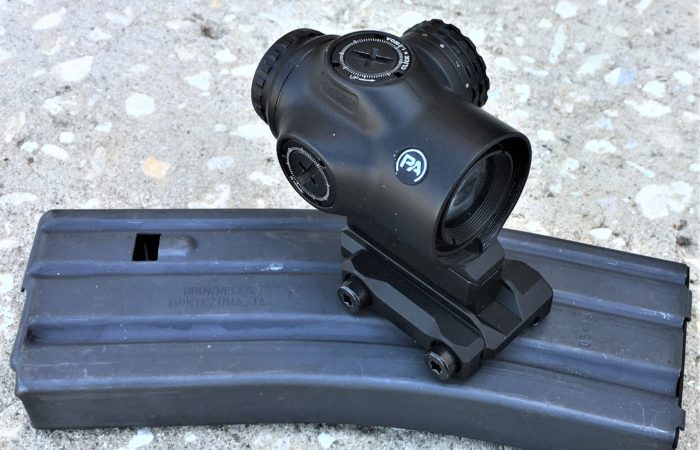
A good rifle optic would be the first tactical rifle accessory I purchase. On all the gun related crap (and lowers, and barrels, and uppers) I put together over the years I could have ponied up for an ACOG. Stop wasting money on "tactical" equipment that does not benefit your current skill level. You might be eying a red dot sight or an variable optic for your new rifle... yes, that's good, but skip all the other crap accessories along the way and purchase a good optic.
From here choose upgrades carefully: ask yourself "What are my deficiencies with my rifle? Will buying accessory x, y, or z help alleviate that deficiency or will more practice help instead?" All the other tactical crap like chest rigs and mag pouches, ect. will come with time. If you practice hard and master your rifle you could roll into a situation (a competition for example) with two magazines in your back pockets and then proceed to wipe the floor with a good amount of your fellow shooters.
Wrapping up:
A spare gun is good, but three or four spare guns will not help you become a better shooter. I know the "disease" is strong every time you spot a lower in the wild. Stop. Put that bill in the bank and save for that ACOG you have always wanted. Get equipment that will help you understand and master your rifle. A Spotting scope, a case of ammo your rifle likes, a spare part skit, and then think about a good optic. Do you think your ready for a rail and flashlight low light shooting when you haven't mastered the fundamentals? no? Skip it. Ask yourself what will help you shoot better... accessory x or will the the cost of accessory x be best spent on ammo and practice instead?
You want to learn how to be a marksman? Starting out with the right equipment will make the path much easier.
Add your comment
Box Stock at 1000 Yards
- Details
- Category: Uncategorised
- Monday, June 17, 2013 - 11:22
Shawn over at looserounds has taken his M16A2 clone and Xm855 green tip ammo to 1000 yards on a man sized target.
"That is three rounds out of 10. Ten rounds of military grade, Lake City green tip M855. Fired from a contract over run Colt M16A2 upper with milspec trigger. Using a parade sling made from cotton. Three rounds of what is the least thought of US issue military ammo made using nothing more than a sling for support while laying prone and using iron sights. I was very pleased. And I do not feel that three rounds out of 10 on this size target with this rifle is a paltry accomplishment. I have made better shots with much higher quality match guns, I have made a 1 mile shot, but this is as pleasing to me as any of those other shots."
That is some awesome shooting and a testament to anyone who might be on a budget who wants to learn to be a rifleman. We don't need tricked out anything... what we do need is the mastery of the fundamentals with an accurate platform. Yesiree that box stock AR15 is an accurate platform.
See the post here.
Add your comment
55 Grain Pill
- Details
- Category: Uncategorised
- Saturday, June 15, 2013 - 14:16
I still use 55 grain ammo for my stash and range work. There are better choices out their for the AR15 for sure: the Mk262 77 grain ammunition has been getting great reports of increased accuracy, lethality, fragmentation, ect. That's just one example of an improved round vs the common 55 and 62 grain options.
The More the Merrier
The biggest issue I have with the improved ammo is the cost and availability. We are all feeling the scarcity and cost on our wallets. I hope this recent chain of events has encouraged people to stockpile. I thought I was doing OK until the legislative fury hit us. I was wrong. I had an emergency stash of AE223 plus the usable stash and 500 rounds of reloads. Total I had around 800 accessible rounds. I blew through my stash during winter with a competition and some range trips. Mistake noted.
I have a budget. Mortgage, kids, all that... and the 55 grain stuff allows me to shoot frequently and store it like there is no tomorrow. I couldn't afford the better stuff and still shoot as often. Barely. I can't wait till the price drops to pre-panic levels... but I am still buying smaller lots during the price gouging and will really stock up once the prices stabilize.
Wrapping Up
I made a mistake of thinking I had enough ammo to practice and enjoy my rifles. Nope. I thought I had accumulated a nice stash of ammo, but now realize that that wasn't even near enough. 55 grain stuff allows me to stockpile and practice with decent defensive / SHTF ammo. Pass me some more 55 grain please.
Add your comment
My Rifle as of 2013
- Details
- Category: The Rifle
- Saturday, June 08, 2013 - 12:07
Originally when I started this blog my rifle (and only complete weapon) was a 20 inch mashup. It had an A1 length stock and was strictly irons. Since shooting it more and going to a few competitions here and there, I started revising my rifle to modernize it while keeping the same trouble free platform relatively unchanged.
From an A1 stock I went to a Vltor A5 stock: I found even the fixed stock A1 too long for any type of body armor. It was too long. On went the A5.
My CompM4 was a trade item and I really like it. A Smaller H1 would be great to reduce the weight, but for now I will take what I can get. It works very well. Eventually i would want to switch to the micro RDS.
Still sticking with the LMT rear BUIS. I would eventually like to upgrade to the KAC adjustable flip up rear, but for now a Magpul BUIS would suffice and will likely be my next upgrade.
At my local practical rifle competitions I am the only one running a rifle. Anyone else "that guy" at the range when they run a rifle?
How does it run?
So far it has only had one string of malfunctions. During a cold winter carbine event the rifle was getting several failure to feeds. I threw out a few bad magazines and switched to Pmags during the event as the Pmags have never given me trouble. Still the failure to feed was present. A fellow shooter noted that using grease in the buffer tube might be the cause of my problems as it is slowing the velocity of the carrier down through the fire cycle. Well indeed I had used some thicker lubricant (Slip 2000 EWL ) for the rifle and it was a cold day. The theory makes sense. If the viscosity thickened enough to slow down the carrier and buffer + spring then it might not have enough momentum to chamber the round. Lesson Learned.
The next trip to the range with spring weather gave me no failures of any kind. I am back to using CLP as well.
Next upgrades:
The rifle is configured well and my only changes will be to save weight. I want the weapon to be relate-able to everyone who might have an 20 inch rifle stuffed away in the safe or perhaps those who want to build a versatile rifle based platform... so no space gun stuff. So whats next? A compensator of some type (read: not an boutique compensator) and a new BUIS that flips down.
How has your weapon changed over the years? Junk gear that had to be thrown out to start over or more of a slow learning process?
Add your comment
The CompM4 Review
- Details
- Category: Equipment Reviews
- Thursday, June 06, 2013 - 13:31
Likes it rough.
I have had my Aimpoint COMPM4 for about a year now. I have competed with it, left it on in the closet from day one to test out battery life, and it has been a constant companion on range trips. We need not argue over the brands pedigree. We know that it has a solid reputation for durability and reliability... but is it worth your coin or will a lower end RDS suffice?
Examining the COMPM4:
I got the M4 after trading for a Vortex 1-4x variable viper PST. My reasons for trading were weight and bulk related as the Vortex with mount started making my rifle feel like the titanic. I appreciate a rifle that's on the trimmer side so I decided to try a used high end red dot sight. The Comp M4 is built tough and is really all business: The one piece machined barrel of the optic is made with precision. The mounting system is robust and has some "heavy metal" construction. Weight is: 11.8 oz with the mount.
The only moving component is the dial switch for dot brightness which leads me to my only complaint. The dial has lots of side to side turning movement before you actually click over a new setting. It has yielded no issues as far as reliability, but it is a complaint I have seen elsewhere. Why on a 700 dollar red dot does the only moving part feel loose as a goose? No Idea. So far so good and it has not gotten worse or affected the optics performance. ( Edit: A member at ARFCOM noted that this is engineered to prevent shock directly to the battery switch! Thanks Tomac!)
2 MOA precision:
The 2MOA red dot has been a great shooting aid. The choice to go with a 2MOA dot has allowed me to dial the intensity down to eliminate glare or bloom (present in many bright red dots) and what is left is a very precise 2MOA dot. I owned a Trijicon RMR but the 6MOA dot and the intense bloom held back my ability to acquire the target. The more precise dot of the CompM4 has been a blessing. Three simple holds have allowed me to make hits out to 400 yards with this optic; however using the dot at 500 yards becomes guesswork as to how far above the target you have to hold... but at this distance I can barely see a white man sized steel silhouette anyway. If pushing past 400 yards is your goal I would suggest magnification.
The optic holds its zero well. I have removed and replaced it, bumped it, scraped it, ect and so far no zero change. Nothing has affected its performance. I would like to throw it into concrete and blast it out with dynamite for you guys but I think a few other people have done things like that before so I don't see the need blow up my optic. If you are thinking about buying a Aimpoint product then you know many people will back up the brands legendary reliability and toughness.
Worthy of the investment?
From a rifleman's perspective... it depends on your needs but overall YES. It has assisted my shooting out to 400 yards very well. Hits are fairly easy with it at that distance. It is lighter than the previous setup I had equipped on this rifle so there is another bonus. At this price range you are getting into ACOG territory but here the question here is which fits your needs better? Will speed up close and "man sized target" capabilities out to 400 yards suit your needs better than 4x magnification and precision the ACOG (or variable) provides? Which do you prefer? So far the CompM4 has complimented my modest rifle skills and it is dump truck tough to boot.
From here I will obtain some other popular red dot sights to review (including entry level setups). The CompM4 will be used as the comparison standard by which to judge other entries into this field. First two on my list for comparison: Lucid and Vortex.
Thanks for reading!
Add your comment
The Rifleman Part III: Ballistics
- Details
- Category: Learning To Shoot
- Saturday, June 01, 2013 - 12:55
Here is the final part of my three part series: Ballistics. This topic is going to be short and sweet because it is simple.
The .223 / 5.56
The little cartridge our rifles shoot is a flat shooting projectile. As discussed elsewhere in the blog I use a 50 yard zero on my red dot and I can co-witness using the IBZ method with iron sights for a 50 yard zero as well.The trajectory of the .223 / 5.56 is roughly the following (depending on barrel length and ammo type ect.) with a 50 yard zero:
50 yards: zero
100 yards: 1 inch high
150 yards: 1.5 inches high
200 yards: zero
300 yards: 7 inches low
400 yards: 20 inches low
Do you see why the 50 yard zero is so popular? We have an easy to obtain zero (sight in 1 inch high at 100 yards) and it allows us to make easy hits at a variety of distances. Some people perfer the 100 yard zero but the bullet drop gets harder to manage at 300 and 400 yards. Anything worth shooting inside my typical shooting distances will not be affected by a 1.5 inch bullet rise with my 50 yard zero.
RDS:
Red dot sights are extremely easy to use for hitting targets at a distance with the 50 yard zero. A direct hold on target will yield hits out to 200 yards. A common complaint is that a red dot will obstruct your target when shooting further distances. I find this quite false. Using a fifty yard zero with a 2MOA red dot allowed me to take hits at 200, 300, and 400 yards without much effort. The red dot obstructs less of the target than my iron sighted A2. For shots at 300 yards I hold my dot over the "face" of my target... in this case a steel silhouette. At 400 yards I place my dot on top of the head and allow the rounds to drop into the mid torso of the steel. At no time was the target obstructed as my 2MOA dot never obscured the target to a negative degree. I like the red dot far more for shooting distance than irons. Much Easier.
A2 Irons:
For the Irons I had to do a bit more work for good shooting. I dialed in my range with the A2 drum before engaging my targets. You cannot reliably hold over with a 200 yard IBZ since the post starts to obstruct the target. To drop rounds onto the torso at 300 yards I have to aim for the "face" of the steel... but at that distance I had a hard time finding the steel and ditto for 400 yards. So we need to adjust the drum.
The biggest issue is target ID at any of these distances. I had a hard time seeing yellow steel against a sand background at 300 yards. The yellow steel at 400 yards was easier to acquire due to the green background behind it.
So that's the basic meat and potatoes of my 50 yard zero. Shooting with red dot sights are easier than irons so consider it an upgrade to your iron sighted setup. Again the limiting factor here is not the sighting system (irons vs RDS) but your ability to find your target at these distances. If you can save your coin for an ACOG then go for it! Advantages are what you *want* when shooting at these distances.
I have my eye on a TA44 for my A2: Also here is my first youtube TEST video. Be sure to put it to 720p for best viewing of the bullet flight.
Thanks for watching!
Add your comment
Rest Easy DOC
- Details
- Category: Uncategorised
- Thursday, May 30, 2013 - 12:49
It has been a crazy few months. A family member was in a hospital bed for a solid month before passing. Karl was a great guy and a hard fought Vietnam Navy Corpsman and survivor of the Tet offensive. You simply cannot get over the simple absence of someone with their passing. How quiet things are around his house now.
Well its time to go shooting again. Still need to get some video up and the goal is, as always, to help new shooters become great shots with their equipment.
Hope to have a new article soon.
Add your comment
Call of Duty is the best thing to happen to the 2nd Amendment in a long time...
- Details
- Category: Off Topic
- Sunday, April 28, 2013 - 21:52
A curious thing happened in the last 10 years with video-games... They continued to improve in visuals and complexity. Along the way someone had a great idea to make a few war games set in the modern time with modern weapons. A legion of gamers (both young and old) have been exposed to modern firearms and related accessories vicariously through video-games. Many of them grow curious with the equipment in the games and start looking at the plethora of designs available to them.
My favorite firearm was a gun called the P90 introduced to me through Counter-Strike in the late 90s. I started watching YouTube videos of the various pieces of equipment I used in the game. I learned that (at the time) I could not purchase a P90 as it was not available to civilians. I also learned of something called the assault weapon ban... and that I could still buy a functional AR15 or AK47 during said ban. Eventually dad stopped by a gun-shop and purchased an honest to goodness AK-47. I was floored when I got to take this gun to the range and enjoy shooting a modern piece of military equipment in civilian legal format. First job? Bagger boy. First thing I purchased with that job? A used AR15 from my uncle's friend.
More modern video games allow the player to unlock different exotic weapons and upgrade them with red dot sights, ACOG's, Suppressors, compensators, ect... Every time I play battlefield 3 (usually at 5 in the morning before the kids get up) I think about how somewhere this very video game is bringing us another gun-owner who's only interest lies with modern military weaponry. He (or she) is young and connected and our gun owning community grows yet stronger. He (or she) can just as easily be a minority inner city kid who learns and understands the second amendment better than many Elmer Fudd's out there. He (or she) is likely to take friends out shooting who themselves have never handled such equipment and there another seed is planted.
Video-Games have become an unlikely ally to gun owners. We have a growing population of youth who cherish their weapons and they become snarling political watch dogs anytime Washington wants to pass feel good legislation. Ladies and Gentlemen, we are on the brink of a new wave of fanatical gun-owners who are politically active keyboard commandos. Fuel the fire and take a young person shooting. If you own a gun store let the young man handle a few of the exotics that he has used in video-games. Encourage, encourage, and encourage some more. The more of our youth we responsibly get behind the trigger... the more our power grows.
Thank you Electronic Arts and Activision.
You mean so much to us and you didn't even know it.
Edit: Do you feel that games have helped or hindered the second amendment? Join the discussion on ARFCOM right now. Polling shows so far that modern war games have a sizable impact on steering individuals towards black rifles at roughly 30% of responders declaring that games made a moderate to high influence on steering them towards black rifles. Surprising results? Good results. :)
Add your comment
The Rifleman Part II: The Rifle
- Details
- Category: Learning To Shoot
- Wednesday, March 20, 2013 - 15:44
"Why are "Rifleman" so concerned about rifles? My carbine can hit targets at 500 yards, I do it all the time."
This is not a black and white issue. It's true you can use a carbine effectively at equal yardage to a rifle, but a rifle length AR15 will have certain advantages.
1) Velocity and terminal effects
In the case of the AR15 we have peak efficient use of the .223 / 5.56x45 is somewhere around 18 inches of barrel. A rifle of any platform, in my definition, would take advantage of the chosen cartridge to the point of peak efficiency. A carbine does not stretch the cartridge to its limit but allows a more compact platform as the tradeoff. For the 5.56x45 we have a velocity "grey area". A few 100 FPS isn't a whole lot when comparing a 16 inch carbine to a 20 inch rifle, but keep going shorter and we really dig away at what makes the 5.56x45 special. The round shoots so flat at typical self defense ranges it may as well be a laser to 200 yards.
"What about fragmentation? It's a moot point if your using good ammo isn't it?"
I know many people say that they use high grain match ammo (insert brand here) which fragments out to forever in their 10 inch carbine. I don't doubt the quality of that stuff and I wish I had the money to shoot stuff like that all the time, I really do... but the fact is shooting the same thing for practice and self defense appeals to me ergo I want one type of ammo for all my shooting. 55 grain M193 is (was) affordable, is still flat shooting, and I can get close to it with my reloads.
2) Reliability
It just so happens that a rifle length AR15 is one of the most reliable members of the AR15 family. Keep this in mind. I did have my first malfunctions with my primary rifle last week at a match, but this needs to chalked up to "don't change anything before the match." I brought untested magazines and they were my downfall. However the Rifle platform has been good to me. Ever see A2 guys asking about buffer systems or H1, H2, H3 buffers? Ever see a 20 inch guy talking about tuning their rifle? O-rings under the extractor? Carbines are reliable, but they have had much development here to ensure that. The AR15 rifle length platforms should give an individual longer service life between parts repair due to it being a soft shooting weapon with a less aggressive gas system.
3) Sight radius
Moot if your an optics only guy, but important to me since I use both irons and a RDS together. Simply put the extra distance between the front and rear sight allows you to see and correct the sight picture easier than if you had a short sight radius. It doesn't make the rifle more accurate, it makes you more accurate with the rifle.
4) The little details
A few final thoughts on the rifle. The extra weight will be a bonus to the shooter since it will keep the sight picture a bit steadier under fire and at rest. I am eager to add a battle comp to see just how little recoil my rifle could have. Furthermore the extra weight will help diminish felt recoil. A little extra weight here is of benefit since the small movements of fine motor muscles and other muscle groups should impact my sight picture a bit less due to the weight.
The AR15 as the Rifleman's weapon
I hear you coming you know... you M14 guys, I heard you around the corner. I knew you were there. "The right tool for the job of a Rifleman and distance shooting is .308 launched from a M1A." Thanks Fred. I know the .308 hits harder, is less affected by the wind, is as common as dirt. All yes, yes, and yes. My goal here is to help and encourage others to become Rifleman. We have so many new shooters out there with rifles set up dopey and topped off with Wal-Mart China optics. In order to reach out to them I need to speak their language, and most likely their language is AR15. As cool as it would be to have the M1A, AR10, or (insert .308 here) as the most popular rifle in America... it's not happening. If we want to be a nation of Rifleman then we need to be able to teach others how to shoot on a widespread and well loved platform.
Final Thoughts:
As a final thought I don't want to start a war here, but I appreciate the rifle for what I am doing. I appreciate the error it removes from my shooting with the flatter trajectory, longer sight radius, and slight increase in weight over carbines. As my aim is to shoot at longer distances and help others towards the same goal, the rifle is the right tool for the job. Home defense or getting out of a car often? Get a Carbine. Shooting longer ranges? The job of shooting accurately at a distance will best be done with a rifle and new shooters will most likely have an AR15.
Add your comment
The Rifleman Part I: The Man
- Details
- Category: Learning To Shoot
- Wednesday, March 20, 2013 - 14:47
What defines a rifleman?
- The Rifle
- Skill with basic principles of marksmanship
- Knowledge of ballistics
It is the application of these principles together that form the basis of a Rifleman.
At what distance or skill does the art of the rifle define a rifleman?
In my opinion, the distance a rifleman can shoot will be at the very least 100 yards. Some might say that sets the bar very low. Indeed, it does. Under 100 yards, the target is very forgiving and large. A man-sized silhouette is easily hit in spite of poor technique. A red dot, or even irons, offers point and click shooting under a hundred yards. Flinching may not even throw the shot enough to miss the target at this range.
As we increase the distance, we begin to see the cohesion of the Rifleman's three principles and how they affect his or her ability to hit the target. If a man has any given rifle and knows the essentials of good shooting, but does not understand the ballistics of that cartridge, he will have a limited effective range. If a man has knowledge of his cartridge but has not mastered the basics of shooting, then that knowledge cannot be applied and he will miss the target. If a man knows the ballistics of the cartridge and the fundamentals of shooting, but is not familiar with the weapon, he will have a handicap with the weapon. Cohesion of the three principles together will allow a shooter to hit a target as far as can be seen.
Why is a rifleman a rifleman and not a sniper?
A rifleman is a versatile individual. He can shoot from a position of concealment and certainly mimic the capabilities of a "Sniper", but his equipment is not specialized enough to hit a very small target at 600 yards with the first shot. Can he? Sure, but a sniper will set up and eliminate more variables to ensure that the target is hit the first time. Ballistic calculations, turret adjustment, range estimation all factor in to a good shot for a sniper. The Rifleman is different. Approaching the same target, he will need to identify the target and set up to engage the target quickly. A Rifleman can estimate range on an educated level but not with the precision of the sniper. His knowledge of marksmanship principles and his projectile allow him to set up quickly and pour accurate fire on to the target. This should take seconds, compared to a sniper's more calculated procedure.
There-in lies the difference. The Rifleman is quick to engage the target with accurate fire at any distance. Not precise fire like a sniper at 600 yards, mind you, but accurate fire. And if he misses? That is why we have Semi-Automatic weapons. If the target closes in to a danger zone, the rifleman can still hold the target at bay and will be far better off defending themselves than a sniper. Versatility and skill at arms are keys to the Rifleman.
Lets discuss some of the basics in a Rifleman's self skill toolbox:
The utilization of his immediate environment:
The ability to manipulate the immediate surroundings of the Rifleman are important. If I want to shoot a target at any distance with accurate fire, I look for a stable platform from which to shoot. For instance, I can throw my pack in front of me to set my rifle on. Much faster than slinging up. Much more stable then simple prone. Setting up against a pole or other hard surface with my left hand against it and the rifle to steady a standing shot is not cheating. It's knowledge. It is not lack of skill, it's eliminating as much of yourself as a variable in your shooting. National Match shooters with their jackets and slings are competent Rifleman, but their techniques do not let us engage the target quickly. The key to steadying your rifle is to let something else steady it for you. Eliminate your wobbly arms as a variable as often as possible.
This is why I prefer 20 round magazines in my AR15. I can use lower supports when prone and they are, in general, less in the way of my shooting.
The proper application of shooting fundamentals:
We all know the basics. Hold your breath. Focus on the front sight (or not if your using a RDS or optics). Squeeze the trigger until the shot comes as a suprise. ECT. A Rifleman should shoot often and master the basics, obviously, for without proper application of the knowledge of marksmanship, he will add variables to the situation. I no longer slowly squeeze the trigger until it surprises me... no, I command it to discharge the weapon. I know my trigger from thousands of dry firings at home and then from time on the range. It is slick and well worn in. Years of use and frequent manipulation of the weapon with dry fire practice aid in upkeep of this basic skill. If you have no one to spot you or teach you it is not impossible to master the basics of shooting. Make sure you concentrate on what you did right and what you did wrong with each shot.
Most importantly -
go shooting. At first, you were scared to drive your car and now it is
not a second thought. Get comfortable with your weapon and practice with
it. Flinches will go away with concentration and experience...
especially since the .223 is about as scary to shoot as a baby duck is
to look at.
Shooting from a position of advantage:
A Rifleman also uses his knowledge to choose positions of advantage. Distance is one advantage. Not everyone can shoot far in this day and age. Even hunters have shown a marked decrease in skill over the last century. Urbanization has diminished the shooting ability of the general populace. If you can hit a target repeatably at 400 yards you have a marked advantage. If you set yourself up from a position of concealment... your advantage is even greater. If you have put the sun into the targets face, yet another advantage is yours. If you are firing from a stable position that allows you to see and cover a greater area with your rifle, another. If a battle can be picked, take advantage of it. A Rifleman takes advantage of every opportunity to eliminate variables against him and his accurate shooting. Develop the skill, apply the skill, and your hits on target will come as easy as breathing.
(revised 3/24/2013)